Still here · Fulton County · Dam inventory GA01494
Atlanta Reservoir No. 1 (Hemphill Reservoir No. 1)
The smaller of two raw-water basins at Atlanta's Hemphill water works, once open for fishing and picnics, now fenced beside a public hilltop park.
From the air
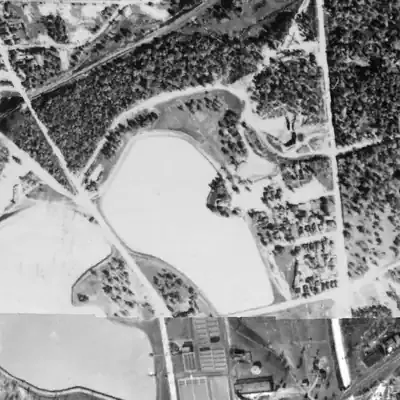
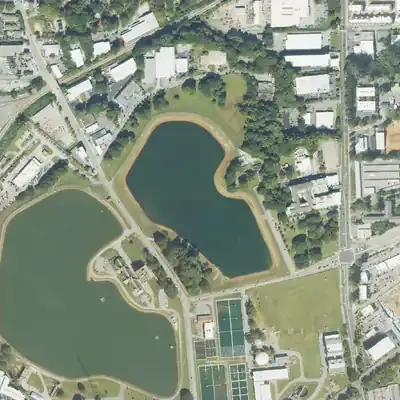
This ridge-top reservoir is already built and full in the 1940 aerial photo, so the dam inventory's 1960 date must reflect later work or an error. It has held water in every photo since.
- First seen
- The earliest aerial photo, from 1940, already shows the basin built and filled with what looks like water.
- Dam in the lidar
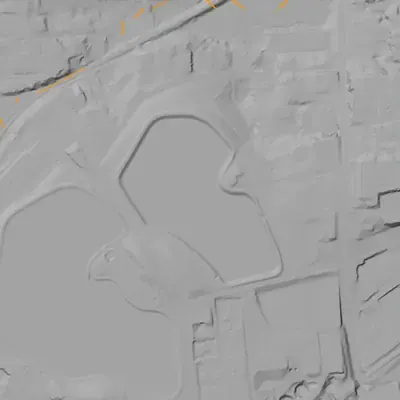
- A ring embankment surrounds the whole basin. Its crest is level at about 980 feet. It stands about 39 feet above the first bench at its foot, and the ground falls 84 to 93 feet to low ground farther north and northeast. No breach, spillway or older dam was seen.
Read from aerial photos taken between 1940 and 2026 and from USGS 3DEP lidar, then checked by a second reading. How the photos were read.
Depth
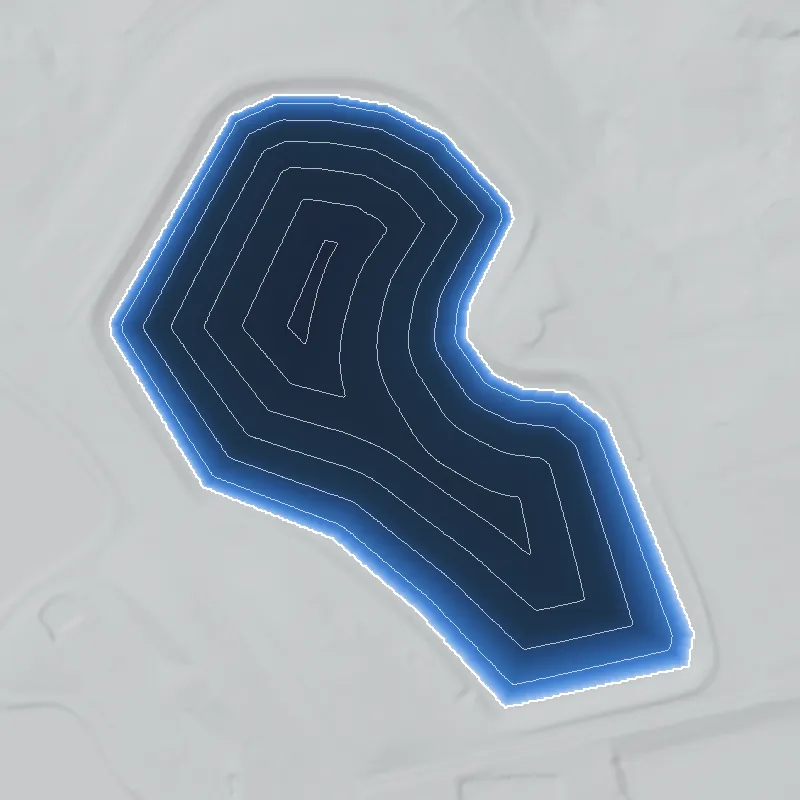
Modeled from the shoreline shape and the dam inventory’s average depth: deepest point about 63 ft. Treat it as an estimate; no survey of the lake bottom was found. How depth is estimated.
History
NID lists this basin at 90 ft high, 20.4 acres and 570 acre-ft. The city's Reservoir #1 is described as a 180-million-gallon reservoir, which fits. It holds Chattahoochee water pumped to the Hemphill treatment plant, not a stream. The Hemphill works opened in 1893 with an initial reservoir of about 200 million gallons; which basin that was is not documented. Locals once fished here and heard concerts at a bandstand until chain-link fences went up before the 1996 Olympics. The city's project page calls Reservoir #1 inactive, with a $3.22 million embankment and drainage project scheduled for July-November 2022. NID rates the dam High hazard, Poor condition. A two-acre public hill opened beside it in March 2022. 12345678
Who built it
Part of the City of Atlanta's second water works (construction contracts 1891, in service by September 1893). Mayor William A. Hemphill took office in 1891 and pushed the new system. City Engineer Robert M. Clayton and Water Works Superintendent William G. Richards designed it, and S. B. Mosby & Co. of Virginia was the contractor. River water is pumped from the Chattahoochee to storage on high ground beside old Howell Mill Road. Records do not show which basin was built first or whether this one dates to 1893. A 1911 engineering report lists a 178-million-gallon reservoir plus a 'new' 250-million-gallon one. 12910
Timeline
- 1875Atlanta's first public water system begins operating at a South River site in the Lakewood community, with a capacity of 3 million gallons a day. The Hemphill station was expected to work alongside it at first. 129
- 1891William A. Hemphill takes office as mayor and pushes a new Chattahoochee-based water system. Construction contracts for the system, including the plant on Hemphill Avenue, are awarded that year. 29
- 1892-1893The Hemphill Avenue works are built to designs by Robert M. Clayton and William G. Richards, with S. B. Mosby & Co. as contractor. An initial reservoir of about 200 million gallons sits on some 55 acres beside old Howell Mill Road, in a park with a summer pavilion. 129
- September 1893A city report says water supplied to Atlanta has been pumped from the Chattahoochee River since September; the Hemphill treatment plant is listed as completed in 1893. 912
- 1908A taller block is added to the Hemphill Avenue pumping station, matching the 1892 block. This concerns the station buildings, not the reservoirs. 113
- November 11, 1911Fire and Water Engineering reports Atlanta storage of 178,000,000 gallons plus a 'new reservoir' of 250,000,000, for 428,000,000 total, and names a 'Hemphill No. 2' pumping station. It does not say which basin is which. 10
- 1921E. H. Wood begins developing Berkeley Park on family farmland that ran south to the Atlanta Water Works. The neighborhood's history says locals were allowed to fish the lakes and used the bandstand for picnics and concerts (undated). 514
- March 29, 1978The Hemphill Avenue pumping station is listed on the National Register of Historic Places (significant years 1892 and 1908). The listing covers the station, not the reservoirs. 13
- 1996Chain-link fences go up around the reservoirs before the Centennial Olympic Games over terrorism concerns, closing to the public a site that had hosted school track meets, proms in a gazebo and lodge, and community barbecues. 6715
- April 30, 2018City project start for WS-Hemphill Reservoir Embankment #1, meant to return an inactive raw-water reservoir to active service. 3
- Late 2020Tunnel work linking the Hemphill treatment plant to the Bellwood Quarry raw-water reservoir (about 2.4 billion gallons) finishes under the city's Water Supply Program. 1617
- December 2021A deal is announced between Friends of Waterworks, the Upper Westside Improvement District and the city Department of Watershed Management to move fences back and return about two acres of the campus to public use. 615
- March 2022The Hill, a two-acre public greenspace at Howell Mill Road and 17th Street, opens with a ceremony including Mayor Andre Dickens. Press dates the event March 8-10, 2022. It has views of the reservoir and city skyline. 18719
- July 7 - November 30, 2022Scheduled construction window on the city's project page for the $3.22 million embankment repair and drainage work. Actual completion and return to service are not confirmed. Likely 3
Names
- Atlanta Reservoir No. 1 / Atlanta Reservoir (Hemphill) #1 Dam
- Primary name in the National Inventory of Dams for GA01494; Georgia EPD's June 2025 inventory lists it as 'Atlanta Reservoir (Hemphill) #1 Dam'. 811
- Atlanta City Water Works Reservoir Number Two
- NID alternate name for this record. USGS NHD also calls the smaller basin (about 18 acres) 'Number Two', so the NID primary name and the NHD name are numbered opposite ways. 820
- Hemphill Reservoir #1
- Name the City of Atlanta uses in its capital project 'WS-Hemphill Reservoir Embankment #1' for the inactive reservoir it planned to return to service. The city's water-future page calls it a 180-million-gallon reservoir. 34
- Atlanta City Water Works Hemphill Reservoir
- Wording used by Urbanize Atlanta and the Upper Westside CID for the reservoir seen from the public hilltop park. 1815
- Waterworks Hill / The Hill at Atlanta Waterworks
- Names for the 2-acre public greenspace on the hill beside the reservoirs, opened March 2022. This is the park, not the reservoir itself. 18715
- Atlanta Water Works lakes
- How Berkeley Park's neighborhood history describes the reservoirs: lakes where locals were once allowed to fish, with a bandstand used for picnics and musical programs. 5
The dam
NID: 90 ft high, 20.4 surface acres, 570 acre-ft normal storage, local-government owner, use Water Supply, High hazard, condition Poor; NID year 1960 conflicts with the 1893 works, and the stream is listed as Unknown. Georgia EPD's June 2025 inventory lists it as Class I (state ID 060-002-00009), 90 ft, maximum storage 642 (units not stated), owner City of Atlanta. The city's project page says one reservoir is inactive and lists embankment erosion and revetment repairs to both reservoirs, permanent drainage, and corrective actions required by Georgia DNR (project start April 30, 2018; scheduled construction July 7 to Nov. 30, 2022; $3,220,000; page status 'Active / Close out'). No contract number found. 8113
- Year in the inventory
- 1960
- Dam height
- 90 ft
- Surface
- 20.4 acres
- Average depth
- about 27.9 ft
- Owner type
- Local Government
Figures from the U.S. Army Corps of Engineers’ National Inventory of Dams. Its “year” is often a rebuild or survey date, and average depth is storage divided by area.
Around the lake
Water
Off-stream storage. Pumps lift Chattahoochee water to the Hemphill reservoirs, where it waits for treatment. The city says the two reservoirs give three to five days of stored supply. Since late 2020 a tunnel also links the plant to the Bellwood Quarry reservoir. NID lists the impounded stream as Unknown.
Civil War
Gen. A. P. Stewart's Confederate headquarters, the Ira R. Foster house, stood about 0.44 km away near Howell Mill Road and Bishop Street, July 16-21, 1864. The 1956 state marker is reported missing. Berkeley Park's history says Civil War historians believe the neighborhood sits on trench lines along Bellemeade Avenue.
Before 1861
The land south of Peachtree Creek was part of Jesse Wood's farm, which ran to the Atlanta Water Works on the south. E. H. Wood began developing Berkeley Park in 1921. Accounts of the 1893 works place the reservoir beside 'old Howell Mill Road'. Land lot and mill ties were not established.
Visiting
Getting there
City-owned and operated by Atlanta Watershed Management; the reservoir itself is fenced and closed. Since March 2022 a two-acre public greenspace (The Hill) at Howell Mill Road and 17th Street sits just outside the fence line.
What you can see
From The Hill you can see reservoir water, the fence line, and skyline views toward Midtown, Downtown and Buckhead. Public accounts do not describe a viewable spillway. The Hemphill Avenue pumping station is part of the operating treatment plant.
Look, don’t dig. Parks, cemeteries and preserves are off limits to digging and collecting, and private land needs the owner’s permission to enter.
Open questions
- Which basin is 'No. 1'? NID names GA01494 No. 1 (with 'Number Two' as alternate) and the city calls Reservoir #1 a 180-million-gallon basin, matching NID's 570 acre-ft. USGS NHD reverses the numbers: its 'Number One' (about 32.8 acres) is the larger western basin and 'Number Two' (about 18.4 acres) the smaller.
- When was the second reservoir built? The 1911 'new reservoir' of 250 million gallons is a lead, not a confirmed date.
- Combined capacity is stated as 345 million gallons (city overview) and 428 (1911); NID's two figures add to about 510. The city's 180 MG for No. 1 and 345 total would leave only about 165 for No. 2, which conflicts with NID's 996 acre-ft (about 324 MG).
- What year was each dam actually built or last rebuilt, given NID's 1960?
- Why does NID rate this dam Poor, and did the 2022 work change its rating? EPD's June 2025 inventory lists only Class I and does not give condition.
- Was Reservoir #1 actually returned to service after the 2022 work? The city's page says 'Active / Close out'.
- Were the water works grounds open to Black Atlantans during the Jim Crow era? No source found.
Know something? Write to hello@historyunderfoot.org. Family papers, photos and deeds often settle these.
Where to look next
- Atlanta Water Works photographs, 56 prints of construction and expansion of the Hemphill Avenue station, 1887-1924 (VIS 280) (Atlanta History Center, Kenan Research Center)
- 1949 aerial photographs of Atlanta (124 frames mosaicked and georeferenced); check both basins and the pavilion grounds (Georgia State University Library, PlanATL / Digital Library of Georgia)
- 'The Enlarged Filter Plant at Atlanta,' Fire and Water Engineering 50(20), Nov. 11, 1911: source of the 'new reservoir of 250,000,000' passage (Excerpted at waterworkshistory.us; original in engineering journal archives)
- Atlanta City Council water committee report on the completed works (1893) and later Water Department annual reports (Atlanta History Center; Georgia Historic Newspapers coverage in the Atlanta Constitution)
- National Register nomination for the Atlanta Waterworks Hemphill Avenue Station (NRIS 78000982, listed 3/29/1978) (National Park Service NPGallery)
- Council legislation and construction contract for WS-Hemphill Reservoir Embankment #1 (2018-2022) (Atlanta City Council Legistar and DWM capital projects page)
- Berkeley Park neighborhood history, for recollections of the bandstand and fishing lakes (Berkeley Park neighborhood association)
- USGS topographic editions for the Atlanta area, to date when each basin first appears (USGS topoView (not checked))
Sources
- Atlanta Water Works Hemphill Avenue Pumping Station Atlanta Buildings: Westside
- Making History City of Atlanta Dept. of Watershed Management (h2o4atl)
- WS-Hemphill Reservoir Embankment #1 City of Atlanta DWM Capital Improvement Program
- Atlanta's Solution to A Sustainable Water Future City of Atlanta DWM (h2o4atl)
- Our History (Berkeley Park) Berkeley Park neighborhood
- Deal struck to finally open Atlanta Waterworks park to public Urbanize Atlanta
- Waterworks greenspace The Hill officially reopens after 26 years Rough Draft Atlanta
- National Inventory of Dams, record extract for GA01494 and GA01495 (project file) U.S. Army Corps of Engineers
- WaterWorks (Atlanta's Upper West Side) Atlanta's Upper West Side (local history site)
- Atlanta Georgia Waterworks (quotes 'The Enlarged Filter Plant at Atlanta,' Fire and Water Engineering 50(20), Nov. 11, 1911) waterworkshistory.us
- Inventory of Dams (June 2025, updated June 4, 2025), Georgia Safe Dams Program Georgia EPD
- Atlanta water and wastewater system overview (CEIP-SystemOverview) City of Atlanta Dept. of Watershed Management
- Atlanta Waterworks Hemphill Avenue Station (NRIS 78000982), National Register listing 3/29/1978 National Park Service NPGallery
- Berkeley Park historic neighborhood document Georgia Conservancy
- Upper Westside Improvement District Reaches Deal to Open Waterworks Hill Atlanta's Upper Westside CID
- Water Supply Program - Atlanta, Georgia H.J. Russell & Company
- No Worries About Water Supply Municipal Sewer and Water magazine
- Exploring the new Atlanta Waterworks park in 19 photos Urbanize Atlanta
- One of the highest points in the city is now open as public greenspace Atlanta Journal-Constitution
- USGS NHD waterbody names (Atlanta City Water Works Reservoir Number One / Two) U.S. Geological Survey