Drained · Location approximate
Lake Palmyra (Westview Cemetery)
A designed lake completed in 1947 just southwest of Westview Abbey, with a Hosmer 'Zenobia in Chains' statue on one shore, drained in the 1970s.
Watermark
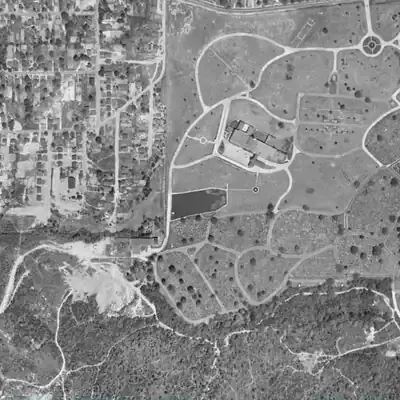
Lake Palmyra, full in 1955
A formal, straight-edged lake of about 1.6 acres beside Westview Abbey, built in the 1940s and seen full in 1949 and 1955. Depth is unknown. By 1968 it had shrunk to a small pool.
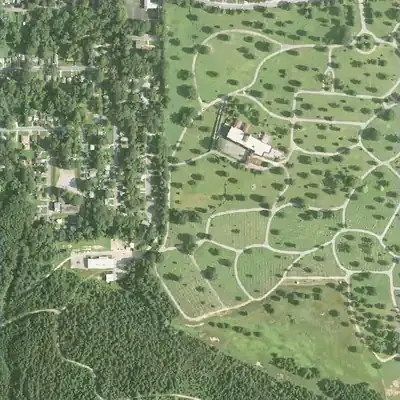
Today: Mown cemetery lawn. Only a faint shallow dip and a worn drainage line along the old east shore hint at where the water was.
- Area
- 1.6 acres
- Method
- Traced from photos
- Checked against
- 1955 aerial
The lake was filled in or built over, so its shoreline was traced from the 1955 aerial photo. Outline traced from 1955 aerial photos. Depth, dam and water level cannot be measured; the ground was regraded after the lake drained. Statue and pier are unconfirmed. How Watermarks work.
From the air
Lake Palmyra, a 1.7-acre lake beside Westview Abbey, appears in 1949 aerials, shrank to a small pool by 1968, became marsh by 1972 and lawn by 1981.
- First seen
- Not in the 1940 aerial, which shows grass and trees; the finished lake is there in 1949.
- Gone
- Gone by 1981, when the site is mowed lawn.
- Dam in the lidar
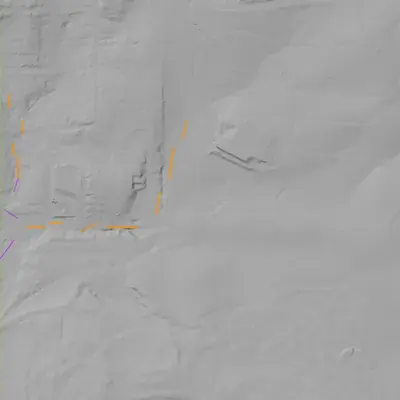
- No distinct dam shows in the lidar, and no breach. The lake sat in a shallow hollow beside the cemetery road, whose bank stands only 0 to 2.5 feet above the basin floor. A notch at the southeast corner, about 962 feet, probably marks the spillway seen as a dark pool in 1949.
Low water and drawdowns
- Between 1955 and 1968: The full lake of about 1.7 acres shrank to a dark pool about a quarter its size. This was a lasting drain, not a seasonal low. The exact year cannot be narrowed.
Read from aerial photos taken between 1940 and 2026 and from USGS 3DEP lidar, then checked by a second reading. How the photos were read.
History
Wikipedia says Lake Palmyra was completed in 1947 just southwest of Westview Abbey and named for Palmyra in Syria. It had 'at one time' a stone pier and, along one shore, one of four known versions of Harriet Hosmer's 'Zenobia in Chains', purchased by 'Asa Candler' in 1943. It was drained in the 1970s because of maintenance issues, and the statue was removed from the grounds. The lake falls within Asa G. Candler Jr.'s 1940 to 1950 memorial-park program, though Wikipedia does not say who built it. The record is thin: one secondary source with no citation attached to the lake sentence, and no dam data, plats, photos or newspaper items. 1
Who built it
Wikipedia says Asa G. Candler Jr., a Coca-Cola heir, took full control of West View in June 1933 and, between 1940 and 1950, built his version of Hubert L. Eaton's memorial park, the 'Garden of Memories'. Westview Abbey construction began in 1943 (also on the cemetery's own history page), an administration building followed in 1947-48, and the Fountain of Life Memorial in 1950. Lake Palmyra, completed in 1947, fits that program, but the source does not tie it to Candler by name or say which stream, spring or water system fed it. It was probably an ornamental lake, but that is an inference. 12
Timeline
- May 1884Twenty-seven Atlanta citizens petition the Fulton County Superior Court to create the West View Cemetery Association. The Association gathered about 577 acres of farms, homesteads and undeveloped land. The exact charter date was not confirmed. 1
- October 9, 1884First burial at West View, Helen Livingston Haskins. The cemetery opened with main burial sections, Rest Haven (an African-American section) and God's Acre (a pauper section used by the City of Atlanta until 1925). 1
- August 1930Frank Adair takes over leadership of the cemetery, with Asa Candler Jr. serving as board president behind the scenes. 1
- June 1933The Adairs relinquish control of West View and Asa G. Candler Jr. takes full control of the cemetery. 1
- 1940-1950Candler builds his version of Hubert L. Eaton's memorial park, the 'Garden of Memories', at West View. 1
- 1943Construction of Westview Abbey begins. 12
- 1943'Asa Candler' buys one of four known versions of Harriet Hosmer's 'Zenobia in Chains', per Wikipedia. Asa Sr. died in 1929, so Jr. is the likely buyer, but the source does not say. It is not stated when the statue reached the lake. Likely 1
- 1947Lake Palmyra is completed just southwest of the abbey, per Wikipedia. It had at one time a stone pier and, along one shore, the Zenobia statue. Likely 1
- 1947-1948Candler builds an administration building that partly wraps around the greenhouse complex's 1921 water tower. 1
- 1951Candler sells West View to three buyers, and 'West View' becomes 'Westview'. The buyers sell to Frank C. Bowen and Raymond B. Nelson in 1952, and the cemetery becomes a nonprofit. 1
- 1970Westview officially ends segregation within the main grounds under Frank Bowen. 1
- 1970sLake Palmyra is drained because of maintenance issues, and the Zenobia statue is removed from the grounds. The exact year is not given. Likely 1
- 2019-2020Wikipedia says Westview was added to the Georgia Register of Historic Places in 2019. The National Register listing date is June 4, 2020 (reference 100005254), per Wikipedia's county list, not checked against NPS records. Likely 13
Names
- Westview Cemetery lake
- Descriptive label used by the map scout, not a documented period name. Wikipedia calls the feature Lake Palmyra, named for Palmyra, the biblical 'city of palms' in Syria. 1
The dam
No dam data found. Sources do not say whether an earthen dam held the lake or whether it was dug and lined. No NID lookup succeeded (token required) and no Georgia EPD Safe Dams record was located. Any dam was presumably breached when the lake was drained in the 1970s, so it may not appear in current inventories. 1
Around the lake
Water
No stream or spring is named for the lake in any source found. The watershed was not verified, and a topographic map or historic aerial should confirm it.
Civil War
Wikipedia says the Battle of Ezra Church (July 28, 1864) took place partly on the cemetery's northern boundaries. In 1889 a Confederate monument and burial ground were established, and two Cohorn mortars lie just beyond a circle of Confederate graves. This is context for the cemetery, not for the lake, whose position relative to the battlefield was not established.
Segregation
The cemetery opened with a separate Rest Haven section for African-American burials and officially ended segregation in the main grounds in 1970. No source says whether Lake Palmyra was open to or restricted to particular groups. The lake existed during the segregated era, from 1947 to 1970.
Before 1861
The cemetery was assembled from farms, homesteads and undeveloped land in the 1880s. Pre-1860 land lots, roads or mills on the lake site were not researched.
Visiting
Getting there
Westview Cemetery is an active cemetery with posted visitor rules: use only the walks and roadways, no jogging, 15 mph vehicle limit, no picnicking or park activities, no pets, and no children under 16 unless accompanied. Areas including the Abbey Mausoleum may be closed for cleaning or maintenance, so call ahead. Hours are on a separate page that was not retrieved. Wikipedia says regular walking tours with Atlanta Preservation Center guides began in 2015; the visitor page does not mention tours, so check current tour schedules.
What you can see
The lake is drained, and whether any basin, embankment or pier stones survive was not established. A visitor can see Westview Abbey and the 1890 Romanesque Revival gatehouse. Check the cemetery's map or ask the office before looking for the site, and stay on roads and paths.
Look, don’t dig. Parks, cemeteries and preserves are off limits to digging and collecting, and private land needs the owner’s permission to enter.
Open questions
- Where exactly was the lake, what fed it, and what happened to the basin after draining? The coordinates are inferred from 'just southwest of the abbey'.
- Where did the Zenobia statue go after it was removed, and is it one of the versions held in a museum or private collection today?
- Was the 1943 buyer 'Asa Candler' really Asa G. Candler Jr.? Asa Sr. died in 1929, so Jr. is likely, but this should be confirmed.
- In which 1970s year was it drained, and did a dam or engineering play a role?
- Was the lake used for recreation or only ornament, and how did segregation-era visiting rules apply?
- When did the pier and statue appear at the lake? Wikipedia says only that the lake had them 'at one time'.
Know something? Write to hello@historyunderfoot.org. Family papers, photos and deeds often settle these.
Where to look next
- Jeff Clemmons, 'Atlanta's Historic Westview Cemetery' (History Press, 2018). Listed in Wikipedia's bibliography but not attached to the lake sentence, so it is a lead, not a confirmed source. (Public libraries and Atlanta History Center library)
- John Bayne, 'Atlanta's Westview Cemetery' (2014), the book Wikipedia says appeared in 2014, the cemetery's 130th anniversary year. (Public libraries; Atlanta History Center)
- Georgia Historic Newspapers and Atlanta Constitution/Journal archives, 1943-1950, for 'Zenobia', 'Lake Palmyra' and 'Candler' plus 'Westview' (statue purchase, lake dedication), and 1970s items on draining. Not searched here (site blocks automated access). (Digital Library of Georgia / ProQuest / Newspapers.com)
- Historic aerials and USGS topographic map editions for the Atlanta area, 1938-40 (before the lake) through the 1950s-1970s, to show the water body and its removal. (GSU Library map collection; UGA Map and Government Information Library; USGS topoView)
- Atlanta Journal-Constitution Photographic Archive: photos of Westview Cemetery, the lake and the statue. (Georgia State University Library / Digital Library of Georgia)
- Westview Cemetery National Register nomination (reference 100005254, listed June 4, 2020 per Wikipedia) and Georgia Register file, likely with a landscape history. NPGallery page could not be retrieved. (NPS NPGallery; Georgia DNR Historic Preservation Division)
Sources
- Westview Cemetery (Atlanta) - Wikipedia Wikipedia
- Westview Cemetery: History Westview Cemetery
- National Register of Historic Places listings in Fulton County, Georgia - Wikipedia Wikipedia