Filled in · City of Atlanta
Ponce de Leon Lake
A four-acre boating lake built in 1890 at Ponce de Leon Springs, later part of an amusement park, filled in 1907 for the Crackers' ballpark.
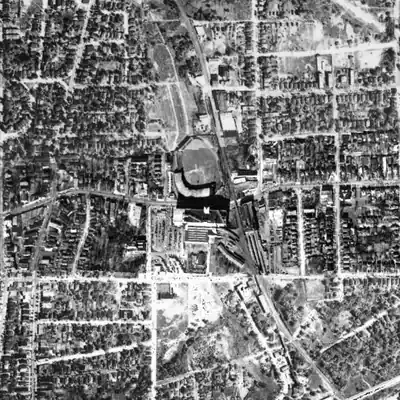
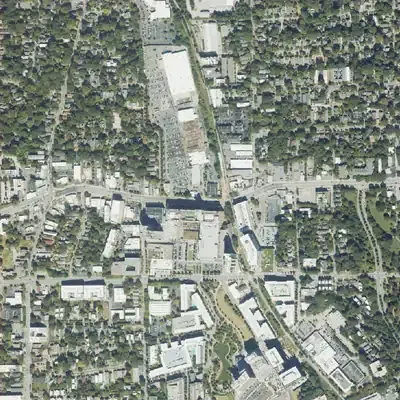
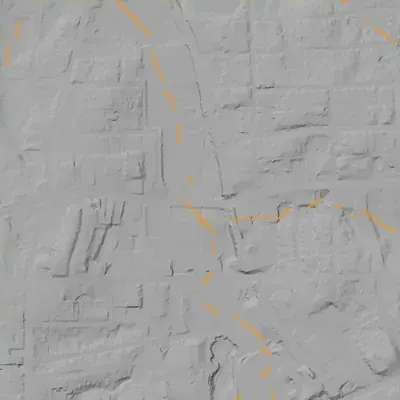
From the air
No aerial photo from 1940 to 2023 shows Ponce de Leon Lake. The earliest one shows a ballpark on the site, which fits the story that the lake was filled in 1907.
- Gone
- The lake was already gone before the earliest aerial photo, taken in 1940, and no later photo shows it.
- Dam in the lidar
- No dam was found. Lidar shows no embankment across the valley. The steep rise on the east side carries the old rail line, now the BeltLine, and is a valley wall, not a dam. Lidar cannot show whether a dam was ever graded away.
Read from aerial photos taken between 1940 and 2026 and from USGS 3DEP lidar, then checked by a second reading. How the photos were read.
History
Ponce de Leon Lake was a man-made lake of about four acres, added in summer 1890 to the Ponce de Leon Springs grounds, which the Atlanta Street Railroad had owned since 1887 and served by streetcar. Landscape designer Julius Hartman is credited with the improvements. By the 1890s the grounds were white-only. In 1903 the Ponce de Leon Amusement Company opened an amusement park there and bought boats, including electric gondolas. The lake was filled in 1907, and Ponce de Leon Ball Park opened on the site on May 23, 1907. The ballpark was torn down in 1966; the Midtown Place shopping center now covers the area. Two outfield magnolias survive near the BeltLine Eastside Trail. 123456
Who built it
The lake was made in summer 1890, three years after the Atlanta Street Railroad Company bought about 30 acres around the springs. Southern Spaces credits landscape designer Julius Hartman with adding rustic benches, graveled paths, a four-acre lake and a music room and ladies' reception room for the pavilion, to enhance the spot's 'natural beauty'; Wikipedia says Hartman proposed the improvements. A smaller Pairs Pond was added at the same time. MLB.com says the lake was for boating and bathing and lay below the streetcar tracks. The impounded stream is not named. The 1874 streetcar line crossed Clear Creek on a trestle at the springs, so the lake was likely fed by that creek or a spring branch (inference). No dam record, height or builder's contract has turned up. 1247
Timeline
- Late 1860sAtlantans visit springs in John Armistead's beech grove two miles east of town. Retired physician Henry L. Wilson names them Ponce de Leon Springs, citing supposed rejuvenating properties. 12
- 1871-1872Armistead starts a residential water delivery service in late 1871 and an omnibus service by spring 1872. 1
- 1874Atlanta Street Railroad extends its Peachtree Street line east to the springs, building a 250-foot trestle over Clear Creek; horse-drawn trolley fare is ten cents. 1
- 1887Atlanta Street Railroad Company buys about 30 acres around the springs. Wikipedia adds that police that year told Black streetcar riders they could not enter the land. Likely 12
- Summer 1890The four-acre Ponce de Leon Lake and the smaller Pairs Pond are added, with graveled walks and summer houses; landscape designer Julius Hartman is credited. MLB.com says the lake was for boating and bathing. 124
- 1890sOnce open to Black and white visitors alike, the springs have become a white-only leisure space by the 1890s; Toton links this to sensationalized 1887-88 newspaper stories about alleged Black crimes. 1
- January 1903Land around the springs (47 acres) is bought by the company that becomes the Ponce de Leon Amusement Company. Work on a theater begins February 22; five carloads of boats, including electric gondolas and two electric launches, are shipped in. 1
- June 1903The Casino theater opens June 1 and the amusement park likely opens June 6, with a carousel and Ferris wheel. Owners later advertise it on postcards as 'The Coney Island of Atlanta.' 1
- 1906The Ponce de Leon Park Association, led by casino lessee Jack Wells, invests $50,000 in new attractions, including an ostrich farm. 1
- 1906MLB.com says the Georgia Railway & Electric Company, owner of the land, bought the Crackers in 1906 and decided to drain the lake. Toton does not mention this, so treat it as single-sourced. Uncertain 4
- May 23, 1907Wooden Ponce de Leon Ball Park, built where the four-acre lake had been drained and filled, opens with more than 8,000 fans at an Atlanta Crackers game; Toton says the crowd was white. 134
- c. 1910A photographed sign at the park reads: 'Ponce de Leon is a private park under city police regulations. No disorderly characters tolerated. Colored persons admitted as servants only.' 1
- 1919-1952The Atlanta Black Crackers play at the park as the white Crackers travel. Toton dates it 1919-1952; Clio says 1920-1937 and 1940-1952. Likely 185
- September 1923Fire destroys the wooden ballpark (September 7 per Atlanta History Center; September 8 per Wikipedia). Rell Jackson Spiller funds a $250,000 concrete-and-steel replacement that opens for 1924 as R. J. Spiller Field. 3910
- 1924 parkThe rebuilt park's segregated seating: the right-field bleachers for white fans hold 2,500 and the left-field seats for Black fans hold the same number. 3
- April 8, 1949Jackie Robinson and the Brooklyn Dodgers play the Crackers in what the Atlanta History Center calls the first integrated professional baseball game in Atlanta. Toton calls it the city's first interracial game. 110
- 1965-1966The Crackers move to Atlanta Stadium after the 1965 season; the ballpark is torn down in 1966. 39
- 1998Florida-based Sembler Co. buys the 20-acre ballpark site and builds the Midtown Place shopping center; the opening date is not confirmed. 1
- 2004The Native Atlantans Club erects the Ponce de Leon Ball Park historical marker behind Whole Foods, with the store's cooperation. 5
- August 14, 2013Trees Atlanta takes cuttings from two surviving magnolias from Spiller Field, which stand between Whole Foods and the BeltLine Eastside Trail. 6
Names
- Ponce de Leon Springs lake / the lake at Ponce de Leon Park
- Descriptive names for the four-acre artificial lake on the grounds of Ponce de Leon Springs. The springs were named for the explorer Juan Ponce de Leon by retired physician Dr. Henry L. Wilson in the (late) 1860s. 12
- Pairs Pond
- A smaller pond added at the same time in summer 1890, surrounded by shaded walking paths and summer houses. It is a separate water feature, not another name for the big lake. Its location is not stated in the sources. 1
- Ponce de Leon Park / Ponce de Leon Ball Park / R. J. Spiller Field
- Names of the ballpark built on the filled lake in 1907. It was called R. J. Spiller Field for the 1924 rebuilt park and, per Wikipedia only, reverted to Ponce de Leon Park in 1933. 39
- The Coney Island of Atlanta
- Slogan the park's owners used by 1906 on postcards, which continued into the early 1910s, per Toton's Southern Spaces essay. 1
The dam
No dam record found. No NID record was identified for this unit, and none of the sources describe an embankment, spillway or outlet. The lake was drained and filled in 1907 (MLB.com puts the draining in 1906-07), so no dam survives to inspect. Any earthen embankment would have been graded away during ballpark construction (inference). 34
Around the lake
Water
Clear Creek ran past the springs: the 1874 streetcar line crossed it on a 250-foot trestle. Its eastern branch starts in Inman Park and Old Fourth Ward, its western branch downtown; Angier Spring lay southeast of the springs, near Belgrade Avenue on the eastern branch. The western branch was buried by the 1930s and much of the eastern branch by 1950. The lake's specific feeder is not named in any source (inference: Clear Creek or a spring branch). Historic Fourth Ward Park (phases opened 2011 and 2012) now holds stormwater in the Clear Creek basin nearby.
Civil War
No source places 1864 lines or camps at the lake itself. Nearby, Union troops camped along the Clear Creek west branch (called the Shermantown Branch) in fall 1864, and Sherman used the Augustus Hurt house on Copenhill, east of the site, as temporary headquarters during the Battle of Atlanta.
Segregation
Toton says the springs were once open to Black and white visitors but were white-only by the 1890s; Wikipedia adds that police turned Black streetcar riders away in 1887. A c. 1910 sign admitted 'colored persons' as servants only. The ballpark had segregated stands and hosted the Black Crackers until 1952.
Before 1861
Toton says Atlantans visited the springs in John Armistead's beech grove by the late 1860s; Armistead sold water by delivery from late 1871 and by omnibus from spring 1872. Wikipedia says a cattle rancher, John Young, built a house near the spring in 1818-1820, but that rests on Wikipedia alone and the date looks too early; treat as uncertain. The Poncey-Highland history dates the amusement park to 1870, which conflicts with Toton's 1903.
Visiting
Today
Midtown Place shopping center on Ponce de Leon Avenue, across from Ponce City Market.
Getting there
Private commercial property. Midtown Place is a shopping center on Ponce de Leon Avenue NE that the public can walk into during business hours. The BeltLine Eastside Trail, a public trail, runs along its east side. No lake, dam or spring remains. Current tenants were not re-verified in 2026.
What you can see
The HMDB-listed Ponce de Leon Ball Park marker behind Whole Foods at 650 Ponce de Leon Ave NE (erected 2004). Two surviving Spiller Field magnolias, reported between Whole Foods and the BeltLine Eastside Trail. No physical trace of the lake, dam or pond.
What to look for
The basin was filled for a ballfield in 1907, so little relief survives; the ballpark's footprint is clear in 1938-1955 aerials.
Look, don’t dig. Parks, cemeteries and preserves are off limits to digging and collecting, and private land needs the owner’s permission to enter.
Open questions
- Which stream or spring branch fed the lake, and how big was the embankment? No dam description turned up.
- Exact date of drainage: 1906 (MLB.com) or early 1907. Toton says only that filling began in 1907, before the May 23 opening.
- Did Georgia Railway & Electric own the land and buy the Crackers in 1906? Only MLB.com says so.
- Whether Pairs Pond was also filled in 1907 or lasted longer, and where it lay.
- Whether swimming ever occurred: MLB.com says bathing; Toton mentions boats but does not describe boating on the lake.
- Was John Young's 1818-1820 house real? The date predates Atlanta's settlement and rests only on Wikipedia.
- Black Crackers start at the park: 1919 (Toton) or 1920 (Clio).
- When did Midtown Place open, given that Sembler bought the site in 1998?
Know something? Write to hello@historyunderfoot.org. Family papers, photos and deeds often settle these.
Where to look next
- Atlanta Constitution articles on the 1903 park opening and boat purchase, cited in the footnotes of Toton's essay (Georgia Historic Newspapers / ProQuest Historical Atlanta Constitution; footnotes of the Toton essay)
- Sanborn Fire Insurance maps of Atlanta, 1911 volumes, for the park and ballpark layout, possibly showing the lake bed after filling (not opened during checking) (Digital Library of Georgia)
- 1949 Atlanta aerial survey: Spiller Field and surrounding blocks shortly before the park's demolition (Georgia State University Library digital collections)
- Atlanta History Center photograph 'Ponce de Leon Springs' (1895), for lake-era imagery (not opened during checking) (Atlanta History Center / Digital Library of Georgia)
- Georgia Railway and Electric Company land and drainage records, 1906-07, and Crackers purchase (Kenan Research Center, Atlanta History Center; Atlanta Constitution and Journal, spring 1907)
- USGS Atlanta quadrangle editions (1890s and 1900s) to see whether the lake was drawn before 1907 (USGS Historical Topographic Map Collection)
- Fulton County deeds for the 1903 47-acre sale and the 1887 30-acre sale (Fulton County Superior Court Clerk deed records)
Sources
- Vale of Amusements: Modernity, Technology, and Atlanta's Ponce de Leon Park, 1870-1920 Southern Spaces (Emory)
- Ponce de Leon Springs (Atlanta) Wikipedia
- Ponce de Leon Ballpark New Georgia Encyclopedia
- Atlanta's first famous baseball park was also home to a giant magnolia tree in center field MLB.com
- Ponce de Leon Ball Park Historical Marker Historical Marker Database
- Propagating the Spiller Magnolias Patch
- Clear Creek (Atlanta) Wikipedia
- Ponce de Leon Ballpark, Home to the Atlanta Crackers Clio
- Ponce de Leon Park Wikipedia
- Home Run for History! Atlanta History Center