Filled in
Brookwood Hills spring-fed lake
A spring-fed lake in the middle of the 1920s Brookwood Hills subdivision, run as a paid swimming lake in the early 1930s and later replaced by the community pool.
Watermark
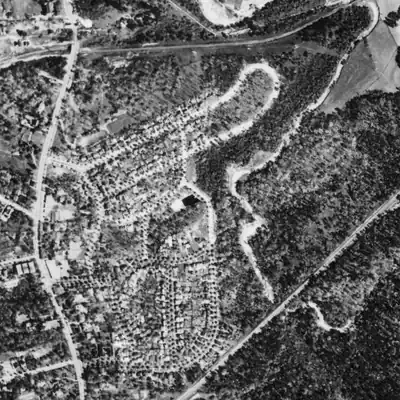
Brookwood Hills Lake, in 1940
A small, sharp-edged, spring-fed lake in the heart of Brookwood Hills, roughly 60 by 35 meters, about a third of an acre. In the early 1930s it was a fenced swimming lake with lifeguards. Depth is unknown.
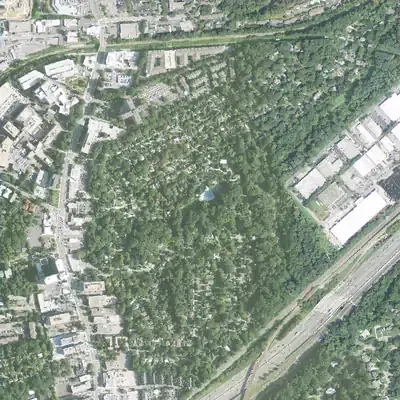
Today: The Brookwood Hills community pool and its deck sit where the lake was, in the same hollow, with a flat lawn or court just to the northeast.
- Area
- 0.3 acres
- Method
- Traced from photos
- Checked against
- 1940 aerial
The lake was filled in or built over, so its shoreline was traced from the 1940 aerial photo. The 1940 photo is the earliest and already shows straight edges, so it may be an early pool. The aerial is shifted, so position is approximate. Exact conversion date unknown. How Watermarks work.
From the air
Aerial photos never show a natural pond here. In 1940 the water is already a straight-sided basin near today's pool, and lidar finds no dam at all.
- First seen
- In the earliest aerial, from 1940, a dark, straight-edged body of water sits at or within about 115 feet of today's pool.
- Gone
- By 1949 the dark water is gone and a bright oval pool with a curved path appears, so a lake-to-pool change probably happened in the 1940s (low confidence).
- Dam in the lidar
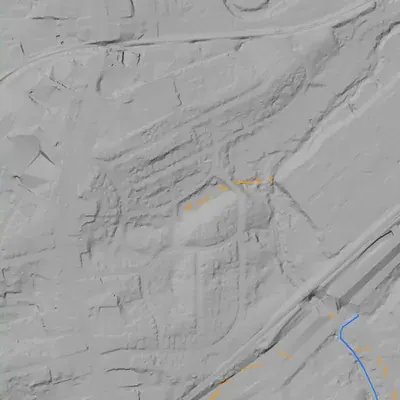
- No dam was found. The pool sits in a closed bowl on a hillside, with ground about 20 feet higher on all sides. A narrow, flat-topped bank to the northeast follows an old road, not a dam. No spillway or breach is visible.
Read from aerial photos taken between 1940 and 2026 and from USGS 3DEP lidar, then checked by a second reading. How the photos were read.
History
Brookwood Hills was founded by Benjamin Franklin Burdett and his son Arthur, with the neighborhood's centennial page giving May 7, 1922. During the development's second phase (1924-1930) the developers set aside land for recreation. The neighborhood's own history says the large pool at its centre was originally a spring-fed lake. In the early 1930s the Burdetts fenced the area, hired lifeguards and charged admission to swim. Under Depression-era financial pressure they deeded the recreation area, lake and some unsold lots to Emory University, which deeded them to the newly formed Brookwood Hills Civic Association in 1939. Residents later built the pool and bathhouse. No source says when or how the lake was drained or filled. 12
Who built it
Set aside for recreation during the second phase of the Burdetts' development, which the club history dates 1924 to 1930 (the first phase began in 1921). The source does not say who dug or dammed the lake, whether a dam existed, or which stream it fed. It is described only as spring-fed. Clear Creek forms the neighborhood's eastern edge, so the lake may have drained toward that creek, but no source says so. 13
Timeline
- 1921-1922Brookwood Hills is founded by Benjamin Franklin Burdett and his son Arthur (Burdett Realty). The club's history says the first phase of lots began in 1921; its centennial page gives May 7, 1922 for the neighborhood's establishment. 12
- 1924-1930During the second phase of development the developers set aside land for recreation. The neighborhood history says the spring-fed lake was in the centre of the neighborhood. The exact date of the lake is not stated. 1
- 1933The National Register record lists 1922 and 1933 as significance years for the district. What happened in 1933 is not stated in the accessible summary and may or may not relate to the lake. Uncertain 4
- Early 1930sThe Burdetts fence in the lake area, hire lifeguards and charge an admission fee to swim. 1
- 1930s (Depression)Because of Depression-era financial pressure the Burdetts deed the recreation area, the lake and some unsold lots to Emory University. Exact year not given. 1
- 1939Emory deeds the recreation area and lake to the newly formed Brookwood Hills Civic Association. The centennial page separately gives June 14, 1939 as the founding date of the Community Club, probably the same body, though the pages do not say so. Likely 12
- After the early 1930s (date unknown)Residents band together to build the pool and bathhouse. The page does not say whether this came before or after the 1939 deed. The large pool now stands where the lake was. 1
- December 21, 1979Brookwood Hills Historic District is listed on the National Register of Historic Places (ref. 79003776). The club's centennial page gives 1980. 324
- 1986The Alex Summers Preserve is purchased, according to the club's centennial page, which does not say by whom. 2
- 1994Brookwood Hills is designated a Conservation District of the City of Atlanta. 2
- 2002A new pool pavilion is completed. 2
- 2019A new park is completed, per the club's centennial page. 2
Names
- Brookwood Hills swimming lake
- Descriptive label for its early-1930s use as a fee-charging swimming lake. Not an attested historical name. 1
The dam
No dam record found. The unit carries no National Inventory of Dams number, and no source mentions an embankment, spillway or Safe Dams permit. Nothing indicates whether it was a dammed pond or a spring basin. 1
Around the lake
Water
The neighborhood is bordered on the east by Clear Creek (Wikipedia), a tributary of Peachtree Creek (Wikipedia's Clear Creek article). The lake is described only as spring-fed and no source names the stream it fed. The club has a separate page, 'Clear Creek - A History', which covers the creek generally.
Civil War
Likely, for the area only. The club's Clear Creek history says Federal troops gained the heights at Brighton Road in the July 1864 fighting and fired into the Clear Creek valley. Wikipedia says Brookwood Hills was built on the Peachtree Creek battlefield. No source ties the lake itself to the fighting.
Before 1861
The club's Clear Creek history says the Creeks ceded the Clear Creek valley by the January 1821 Indian Springs treaty, and that Meredith Collier settled along Clear Creek in 1822. It also places Ben Walker's mill, c. 1834, near the Park Drive bridge. That page covers the creek generally, and no source names a land lot or mill at the lake.
Visiting
Getting there
The site is a private membership club, the Brookwood Hills Community Club, on over 5 acres with a swimming pool, park and tennis facility. Membership is by application with letters of recommendation and Board approval. Homeowners inside the neighborhood may apply, and a limited number of non-resident memberships are considered each spring. It is not a public park. The pool's street address was not confirmed.
What you can see
No lake survives. A visitor can see the neighborhood from public streets, including its curving roads and 1920s-era houses. The pool, pavilion and park are inside the club and open to members only. The 1979 National Register district covers the neighborhood.
Look, don’t dig. Parks, cemeteries and preserves are off limits to digging and collecting, and private land needs the owner’s permission to enter.
Open questions
- Exact site of the lake versus today's pool, and whether the pool sits in the old lake basin or beside it.
- Was the lake drained, filled or converted, and in what year? The history page says only that the pool 'is today' where the lake was.
- Was there a dam or embankment, and what stream or spring fed it?
- What is the 1933 significance year in the National Register nomination?
- Were swimming and club membership restricted by race? The club histories accessed say nothing. Deeds, covenants and the National Register nomination should be checked.
- Which year did the Burdetts deed the property to Emory, and did Emory operate it?
- What is the pool's opening date, and was it built before or after the 1939 deed?
Know something? Write to hello@historyunderfoot.org. Family papers, photos and deeds often settle these.
Where to look next
- National Register nomination for Brookwood Hills Historic District (ref. 79003776), which may describe the lake, the 1933 date and Burdett Realty plans. The NPGallery scan is image-only. (NPGallery / Georgia Historic Preservation Division)
- Club page 'Centennial History' and Arthur Burdett Sr.'s 1970 letter about the founding, which the earlier researcher reported the page mentions; check for the full letter or photos. (Brookwood Hills Community Club)
- Burdett Realty plats and sales brochures for Brookwood Hills phase two, c. 1924-1930. (Atlanta History Center (Kenan Research Center) and Digital Library of Georgia plats)
- Emory University records on the Burdett transfer and the 1939 deed to the Civic Association. (Emory University archives (Rose Library); Fulton County Superior Court deed books)
- Historic aerials: GSU 1949 Atlanta aerials would show the lake or pool; any 1938-40 Fulton coverage and earlier USGS Atlanta quadrangles should be checked for the water body. (Georgia State University Library aerials; USGS topoView)
- Newspaper ads and notices for the fee-charging swimming lake, early 1930s. Try Georgia Historic Newspapers plus the Atlanta Constitution and Atlanta Journal via ProQuest and the Atlanta Daily World. (Georgia Historic Newspapers; Atlanta Journal-Constitution archives)
- Club page 'Clear Creek - A History', for the creek the neighborhood borders. (Brookwood Hills Community Club)
Sources
- History - Brookwood Hills Community Club Brookwood Hills Community Club
- Centennial History - Brookwood Hills Community Club Brookwood Hills Community Club
- Brookwood Hills (Wikipedia) Wikipedia
- NRHP record: Brookwood Hills Historic District (79003776) National Park Service