Filled in · City of Atlanta · Location approximate
Lake Abana (Grant Park)
Grant Park's spring-fed lake, popular from the 1880s and a segregated swimming spot. Closed and filled between 1958 and the 1960s; zoo land and parking took its place.
Watermark
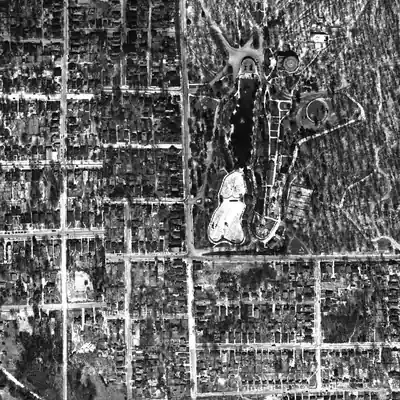
Lake Abana, full in 1949
Grant Park's long, narrow lake ran south from the Erskine fountain courtyard, about 650 feet long and 150 to 190 feet wide, with two small islands. It was full in 1949 and closed by the 1960s.
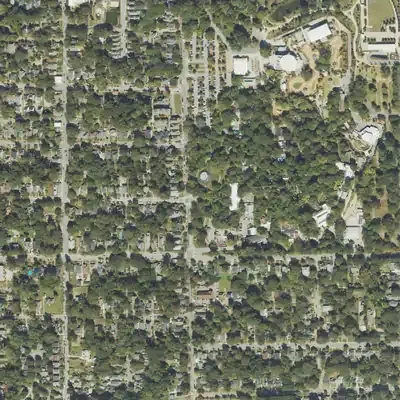
Today: Zoo Atlanta grounds cover the lakebed, now a flat graded floor with tree canopy, exhibits and paths. The overlook courtyard at the north end was restored in 2024-25.
- Area
- 1.7 acres
- Method
- Traced from photos
- Checked against
- 1949 aerial
The lake was filled in or built over, so its shoreline was traced from the 1949 aerial photo. Traced from a 1949 photo, so the size is approximate and shadows blur the edges. The swimming pool south of the lake is not shown. Depth is unknown because the bed was graded. How Watermarks work.
From the air
Lake Abana was a long, narrow lake with two small islands, next to a huge concrete swimming pool. Both were gone by 1968, and zoo exhibits now cover the site.
- First seen
- The earliest aerial, from 1940, already shows a complete lake and pool; records place the lake in the 1880s.
- Gone
- The lake and pool are still there in 1955 and gone in the 1968 aerial.
- Dam in the lidar
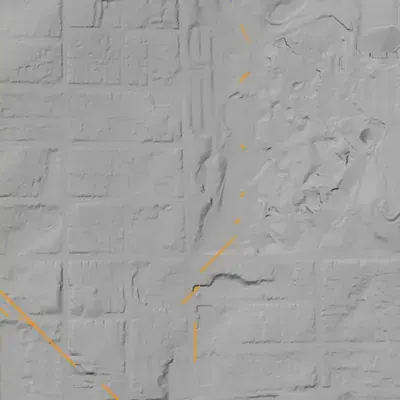
- Lidar shows the south end closed by a broad rise under Cherokee Avenue, about 15 to 16 feet above the old pool floor and up to 26 feet above the gully below. It merges into the hillside, with no clear crest, spillway or breach. It may be road fill rather than a dam. Uncertain.
Low water and drawdowns
- 1949 possibly: The concrete swimming pool south of the lake looks bright and stained, as if empty or very shallow. This is probably a pool emptied for winter, not a lake drawdown, and is uncertain.
Read from aerial photos taken between 1940 and 2026 and from USGS 3DEP lidar, then checked by a second reading. How the photos were read.
History
Lake Abana was a spring-fed lake in the southwest corner of Grant Park, Atlanta's oldest park, and was drawing crowds by the 1880s. The city enlarged it to six acres with two islands in 1900 and had it equipped for swimming and boating by 1902. Expanding the lake to manage storm water is the one known piece of the Olmsted Brothers' park plan that was carried out. Atlanta Magazine says the city drained it in the 1960s to avoid integrating it. Sources disagree on the closing date (1958, 1960, or 'the 1960s') but agree the zoo took the site. The Abana Courtyard overlook above the old lake was restored in 2024-25. 1234567
Who built it
Atlanta 100 describes a lake of several mineral springs in use from the 1880s; the New Georgia Encyclopedia says Lake Loomis was built beside it in 1888 and the two later merged, and that Willow Brook and Constitution Spring were contaminated, so from 1906 the lake was filled with city reservoir water. Grant Park itself came from Lemuel P. Grant's deed of May 17, 1883. No source found names who built the first dam or basin. The Olmsted Network says expanding the lake to manage storm water was the one Olmsted element carried out; The Cultural Landscape Foundation says Olmsted proposed it in 1903. Wikipedia's claim that the original park included the lake for storm-water runoff is a lead only, and it fits poorly with the 1903 Olmsted date. 18591011
Timeline
- May 17, 1883Lemuel P. Grant's deed for the park is executed. The state marker gives 87.5 acres for the park; the New Georgia Encyclopedia says he proposed about 100 acres. 101
- 1880sGrant Park is home to a popular lake fed by several mineral springs, later called Lake Abana. Likely 8
- 1886About 10,000 people reportedly watch performer 'Professor Leon' tightrope-walk across the lake while his wife gives a sewing demonstration on a 50-foot platform. Only the Atlanta 100 was found reporting this. Likely 8
- 1888Lake Loomis is built next to Lake Abana; the two lakes later merge. 1
- 1889Businessman George V. Gress buys a defunct circus and gives the animals to the city's small collection, which began in 1886 with a fawn. This is the start of Zoo Atlanta. 112
- April 4, 1890After the city buys 44 more acres, the park totals 131.5 acres, according to the state marker. 10
- 1900Lake Abana is enlarged again, from four acres to six acres, and given two islands. 1
- 1902The lake is equipped for swimming and boating, with a large pavilion at one end where motion pictures were shown. 11314
- 1903Olmsted Brothers are contracted for a Grant Park plan; John Charles Olmsted visits and proposes expanding Lake Abana to manage storm water. 59
- Nov. 3, 1905A postcard of Lake Abana by E.C. Knopp Co. is mailed from Atlanta to Union City, Tennessee. 15
- 1906Because Willow Brook and Constitution Spring were contaminated, the lake is filled with city reservoir water from this year. 1
- 1909Olmsted visits again for planting and circulation plans. The Olmsted Network says expanding Lake Abana for storm water is the only known part of the plan built. When it was built is not stated. 5
- By late 1912The Erskine Memorial Fountain, dedicated downtown on May 2, 1896, is moved to Grant Park, where it overlooks Lake Abana. Wikipedia is the only source found. Likely 16
- 1917A pool measuring 500 by 200 feet is added in the park. The Olmsted Network later calls a large pool adjoining the lake. Likely 15
- 1930A 1930 description quoted in Palmer's timeline says pools were kept in Piedmont, Grant, Maddox, Mozley and Cochran parks for white bathers, and one in Washington Park for Black residents. It does not name the lake. Likely 14
- 1941Lane Brothers photographers record 'Grant Park Lake; Lake Abana' on a negative now at Georgia State University. 7
- 1958The Porch Press says the lake closed this year, 'the same year the city integrated public facilities,' and was drained for zoo expansion. That conflicts with the 1963 pool integration date. Uncertain 217
- 1960Hannah Palmer (Earth Island Journal, adapted from her book) says the city filled in Lake Abana and expanded the zoo in its place, and quotes a caption about a sea lion in the 'Grant Park Pool.' Likely 6
- June 12, 1963Atlanta's public pools desegregate on opening day; the coverage found centers on Lake Clara Meer in Piedmont Park. Grant Park and Lake Abana are not named. 1714
- 1960sThe New Georgia Encyclopedia says the pool and lake were drained in the 1960s. The Atlanta 100 says it was for a zoo parking lot; Atlanta Magazine says the city did so to avoid integrating the swimming hole. Likely 184
- Aug. 2024Grant Park Conservancy begins a $230,000 restoration of the Abana Courtyard overlook: permeable pavers in place of asphalt, drainage fixes, green space and an iron rail on the brick wall. 21819
- 2025The Conservancy's Dec. 24, 2025 year-in-review says the Abana Courtyard, closed for decades, has been reclaimed, with new pavers and greenspace around the Erskine Fountain. An exact opening date was not found. 3
Names
- Grant Park Lake
- Catalog label on a 1941 Lane Brothers photograph envelope at Georgia State University: 'Grant Park Lake; Lake Abana.' 7
- Lake Loomis
- Second lake built beside Abana in 1888; the New Georgia Encyclopedia says the two later merged. Origin of the name not found. 1
- Lake Albana
- Misspelling in the Olmsted Network text, which describes the same lake. 5
The dam
No National Inventory of Dams entry or Georgia Safe Dams record was located; the NID services queried were unavailable, so this is unverified rather than confirmed absent. No dam height, spillway, engineering contract or Safe Dams classification appears in any source read. The lake was described as spring-fed and later topped up with city reservoir water, so it may have been a shallow basin with an embankment rather than a stream dam. That is an inference, not a documented fact. The lake was filled, so no dam is in service. 15
Around the lake
Water
Fed by mineral springs. The New Georgia Encyclopedia says Willow Brook, which ran through the park, and Constitution Spring were contaminated, so from 1906 the lake was filled with city reservoir water. Olmsted's plan also had the lake expanded to take storm water. The receiving stream and watershed are not named in the sources found.
Civil War
Fort Walker, an earthwork from Atlanta's 1863-64 ring of defenses laid out by Lemuel P. Grant, survives in the park's southeast quadrant, about 0.5 km from the old lake by the marker's coordinates. Grant later donated the park land. The state marker says the fort never came under direct fire; the nearest fighting, the Battle of Atlanta on July 22, 1864, was half a mile northeast. It calls the fort one of the few surviving traces of the ring, and the Conservancy plans an educational plaza at its base.
Segregation
Atlanta's public swimming was segregated: a 1930 description quoted by Palmer lists Grant Park among parks with pools for white bathers only. Atlanta's pools integrated on June 12, 1963. Palmer and Atlanta Magazine say the city closed and filled the lake rather than integrate; the Porch Press dates the closing to 1958. The exact date and the city's stated reason remain to be found in city and newspaper records. Rough Draft's claim that the drain followed the 1964 Civil Rights Act is inconsistent with the 1963 integration date.
Before 1861
Lemuel P. Grant owned the land he donated for the park. His 1863 defense works were built with enslaved laborers paid for at $1 a day, according to the Fort Walker marker. No pre-1860 mills, roads or land-lot data for the lake site were found.
Visiting
Today
Zoo Atlanta grounds and parking. The Grant Park Conservancy finished restoring the brick-and-stone Abana Courtyard overlook in 2025.
Where it was
About 6 acres in the southwest corner of Grant Park, behind the Erskine Fountain near Cherokee Avenue, under today's zoo parking.
Getting there
The lake is filled. Sources say the bed became zoo grounds and parking; zoo areas require admission. The Abana Courtyard overlook behind the Erskine Fountain was restored by the Grant Park Conservancy and reported reclaimed in 2025; check with the Conservancy or the city for current hours and access.
What you can see
The Abana Courtyard: a brick overlook wall above the former lake, with new permeable pavers and green space around the Erskine Memorial Fountain; the restoration also called for an iron rail on the wall. The water surface, islands, pavilion and pool are gone. Fort Walker earthworks and marker are in the park's southeast quadrant.
What to look for
The Abana overlook behind the Erskine Fountain near Cherokee Avenue; the level former lake bed under the zoo parking; the lake outline in 1938-1955 aerials.
Look, don’t dig. Parks, cemeteries and preserves are off limits to digging and collecting, and private land needs the owner’s permission to enter.
Open questions
- Exact date lake and adjoining pool closed and were filled: 1958, 1960, or later 1960s?
- Did the city say why it closed it (zoo expansion, cost, contamination or integration)? Contemporary Atlanta Constitution and city council records are needed.
- Who built the first dam or embankment, and when? Are Willow Brook and Lake Abana connected in any drawing?
- How did Lake Loomis relate physically to Abana, and how did the 1917 pool relate to the lake? Palmer's article quotes a caption about a sea lion in the 'Grant Park Pool'; is that the same pool?
- Where does the name Abana come from? No source explains it.
- Was Olmsted's storm-water expansion built in 1909-1910 or earlier?
- The Atlanta Magazine and Rough Draft accounts of integration motives are not directly sourced to city records.
- Was the lake ever restricted to white swimmers by ordinance or policy? Only the 1930 park-pool description and the later closing narrative point to it.
Know something? Write to hello@historyunderfoot.org. Family papers, photos and deeds often settle these.
Where to look next
- Atlanta History Center Kenan Research Center: Lake Abana photograph (Gravure Illustration Co.); its record dates are a placeholder range (Atlanta History Center via Digital Library of Georgia)
- Lane Brothers Commercial Photographers negative, 'Grant Park Lake; Lake Abana' (1941) (Georgia State University Special Collections)
- Grant Park Pavilion photograph showing its reflection in Lake Abana (Atlanta History Center digital collection)
- Lake Abana, Grant Park, 1898 (Atlanta guidebook image; not viewed, unverified) (Georgia State University Digital Collections)
- Witt Brothers Lake Abana postcard (hpc1230) (Georgia Archives Historic Postcard Collection)
- Atlanta Constitution and Atlanta Journal coverage of the closing and filling of Lake Abana and the Grant Park pool, 1957-1965; also the 1886 tightrope event (Georgia Historic Newspapers and ProQuest archives; Atlanta-Fulton Public Library)
- City of Atlanta Parks Department and Board of Aldermen/City Council minutes, 1957-1965, for the closing/fill decision and zoo parking (Atlanta City Archives, Atlanta History Center)
- UGA 1938-40 Fulton/DeKalb aerials and GSU 1949 Atlanta aerials to show the lake and pool before filling (not viewed) (UGA Map and Government Information Library; GSU digital collections)
- USGS Atlanta topo editions (1890s to 1960s) to compare lake outline over time (not viewed) (USGS topoView)
- Hannah S. Palmer, The Pool Is Closed (LSU Press, 2024), notes on Lake Abana (publisher page not re-verified) (LSU Press)
- Olmsted Brothers Grant Park plan drawings (1903-09), Job file for Atlanta parks (Olmsted Research Guide Online (Olmsted Network); Frederick Law Olmsted NHS)
- Grant Park Historic District National Register nomination (1979) (Georgia Historic Preservation Division / NPS)
Sources
- Grant Park New Georgia Encyclopedia
- Grant Park Conservancy Restoring Abana Courtyard The Porch Press
- Grant Park Conservancy Shares 2025 Progress and What's Ahead The Porch Press
- Swimmers and boaters once flocked to a six-acre lake in Grant Park Atlanta Magazine
- Grant Park Olmsted Network
- The American South's Missing Pools and Lakes (No Entry) Earth Island Journal
- Grant Park, Lake Abana (1941 Lane Brothers negative) Georgia State University via Digital Library of Georgia
- Grant Park's Long Lost Lake The Atlanta 100
- Grant Park, GA The Cultural Landscape Foundation
- Grant Park historical marker (060-107) Historical Marker Database
- Grant Park, Atlanta Wikipedia
- Zoo Atlanta New Georgia Encyclopedia
- Grant Park (amusement parks history page; reproduces New Georgia Encyclopedia wording) Howard Lake / RootsWeb
- Ghost Pools timeline Hannah S. Palmer
- Lake Abana, Grant Park. Atlanta, Ga. (E.C. Knopp Co. postcard, 1905) Atlanta Preservation Center via Google Arts & Culture
- Erskine Memorial Fountain Wikipedia
- Photos: How Atlanta pools integrated in 1963 Atlanta Journal-Constitution
- Pair of restoration projects launch at Grant Park in Atlanta Rough Draft Atlanta
- The Grant Park Conservancy Breaks Ground on Two Major Restoration Projects The Porch Press